




























































































































































How to Remove Common Warts at Home: What Actually Works
Author: RVLNSV PRASAD
Updated On: September 2026
About Us
Author Bio
Editorial Policy
Contact Us
Introduction
If you are searching for how to remove common warts at home, you will probably find dozens of suggestions before you find a clear answer. Some websites recommend salicylic acid, while others promote duct tape, freezing products, apple cider vinegar, garlic, or essential oils.
The problem is not a lack of remedies. The problem is knowing which options have reasonable evidence, which ones have mixed evidence, and when home treatment should stop.
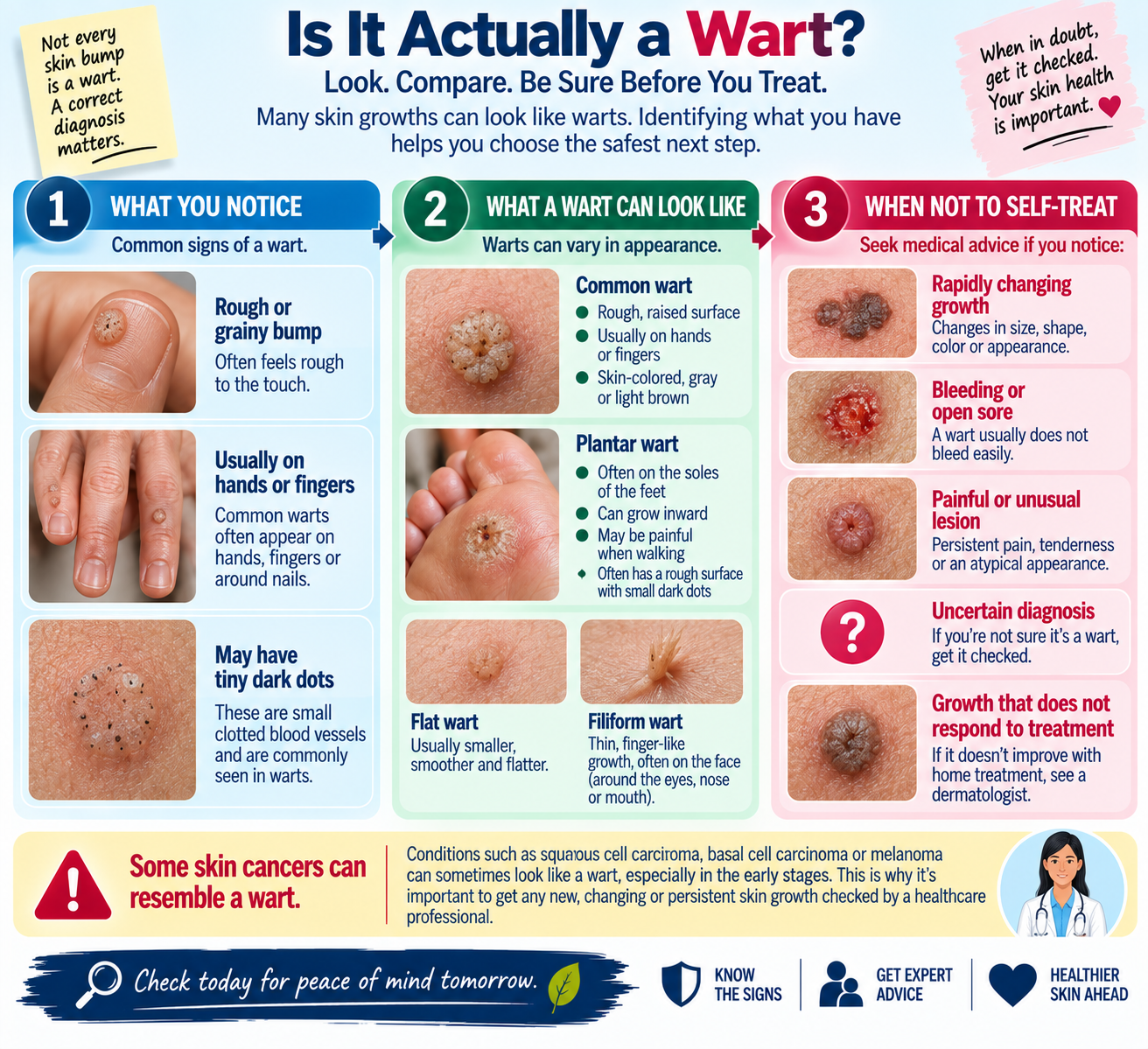
Common warts are usually harmless.
growths caused by certain types of human papillomavirus (HPV). They commonly appear on the hands and fingers, although warts can occur in other areas as well. The American Academy of Dermatology explains that many warts eventually disappear without treatment, but clearance can take months or even years. American Academy of Dermatology: Warts FAQs
For someone with one or a few small, typical common warts, an over-the-counter treatment containing salicylic acid is one of the better-established home options. Dermatologists also recognize appropriate home freezing products and duct-tape treatment as possible approaches, although the evidence and effectiveness differ between them. American Academy of Dermatology: At-home wart treatment
But there is an important step before treatment: make sure the growth really is a wart.
A rough bump can have several possible causes, and treating the wrong skin lesion at home can delay proper diagnosis. Mayo Clinic explains that healthcare professionals can usually diagnose common warts by examining them, while uncertain lesions may require additional evaluation. Mayo Clinic: Common warts diagnosis and treatment
This guide takes a different approach from the typical “10 miracle wart removers” article. Instead of simply listing remedies, it explains how to choose a reasonable home treatment, what progress should look like, how to avoid spreading the wart, what popular remedies deserve caution, and when professional treatment makes more sense.
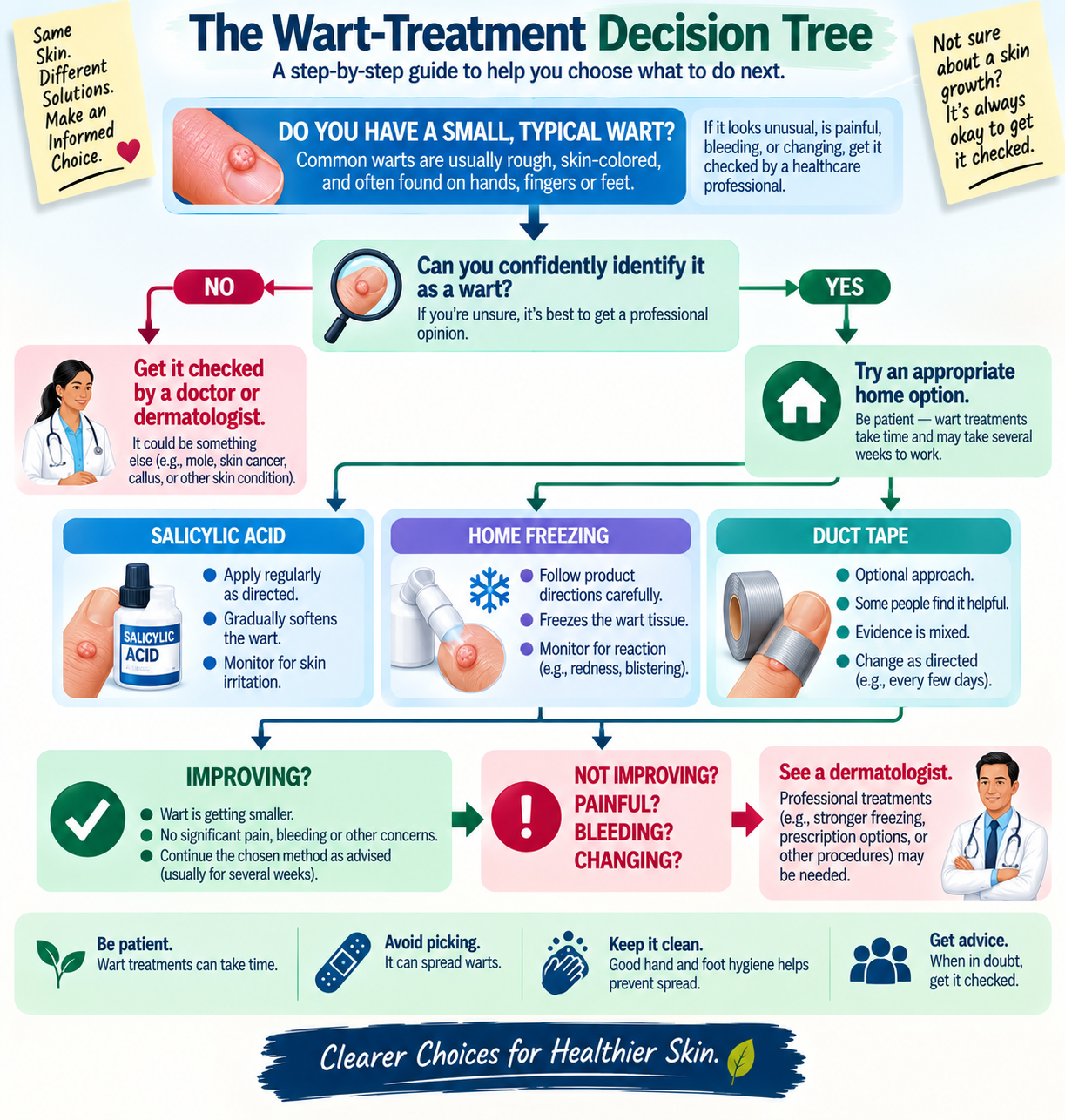
Quick Answer
For a typical small common wart on the hand or finger, salicylic acid is one of the most practical evidence-based home treatments.
It works gradually by removing layers of wart tissue. Depending on the product, salicylic acid may be available as a liquid, gel, pad, or patch. The American Academy of Dermatology recommends following the product directions carefully and using consistent treatment rather than expecting an immediate result. AAD: Dermatologists’ tips for at-home wart treatment
Home freezing products can also help some small warts, although an at-home freezing product is not the same as professional cryotherapy performed with liquid nitrogen. AAD: Warts diagnosis and treatment
Duct tape is another option sometimes used for common warts, but research has produced mixed findings. It should not be presented as a guaranteed cure. Mayo Clinic: Common warts treatment
Most importantly, wart treatment usually requires patience. NHS guidance says pharmacy treatments can take up to three months and may irritate the skin or fail to work. NHS: Warts and verrucas
Key Takeaways
- Salicylic acid is one of the most established home treatments for common warts.
- Home freezing products may help some small warts.
- Professional cryotherapy is different from an over-the-counter freezing product.
- Duct tape has mixed evidence.
- Wart treatment often takes weeks rather than days.
- Some warts disappear naturally without treatment.
- Not every rough skin growth is a wart.
- Do not cut or burn a wart yourself.
- Do not use ordinary common-wart remover on genital lesions.
- Diabetes, poor circulation, reduced sensation, and weakened immunity require additional caution.
- Picking, scratching, and shaving over a wart can contribute to spread.
- A wart that repeatedly returns may need professional reassessment.
What Is a Common Wart?
A common wart is a non-cancerous skin growth associated with certain types of HPV.
Common warts frequently appear on the hands and fingers. They may feel rough and raised, and some have tiny dark pinpoint areas that represent small blood vessels.
The good news is that common warts are generally harmless. The frustrating part is that they can be persistent.
The American Academy of Dermatology says untreated warts may last months or years. American Academy of Dermatology: Warts FAQs
Mayo Clinic similarly explains that most common warts eventually disappear without treatment, but this can take a year or two, and new warts may develop nearby. Mayo Clinic: Common warts
That creates an important distinction:
A wart can be harmless and still be worth treating.
Someone may want treatment because the wart catches on clothing, interferes with work, becomes irritated, spreads to nearby skin, or causes cosmetic concern.
Before You Treat It, Ask: Is It Really a Wart?
This is one of the most important parts of how to remove common warts at home safely.
A rough or raised bump should not automatically be treated as a wart.
A healthcare professional can usually identify a wart by looking at it. If the growth looks unusual or does not respond to treatment, further evaluation may be needed. Mayo Clinic notes that a biopsy can sometimes be used to distinguish a wart from another type of skin growth. Mayo Clinic: Common warts diagnosis
A typical common wart may be
- Rough or grainy.
- Raised above the surrounding skin.
- Located on the fingers or hands.
- Present as a single growth or several growths.
- Associated with tiny dark pinpoint areas.
When home treatment may be reasonable
| Situation | What to consider |
|---|---|
| One small typical wart on a finger | Home treatment may be reasonable. |
| A few small common warts | Home treatment may be considered. |
| Wart is gradually shrinking. | Continue according to instructions. |
| Mild treatment irritation | Follow product guidance and monitor |
| Severe irritation | Stop and reassess. |
| Bleeding wart | Seek medical assessment. |
| Rapidly changing lesion | Seek medical assessment. |
| Facial growth | Professional assessment is preferable. |
| Genital growth | Do not use ordinary wart remover. |
| Many spreading warts | Consider professional evaluation |
| Unsure whether it is a wart | Get the diagnosis checked. |
The American Academy of Dermatology recommends seeing a dermatologist for warts on the face or genital area, changing or painful warts, bleeding or burning lesions, many warts, uncertain diagnosis, unsuccessful home treatment, diabetes, or a weakened immune system. AAD: Warts diagnosis and treatment
Salicylic Acid: The Most Practical Starting Point for Many Common Warts
If your goal is common wart removal at home, salicylic acid deserves serious consideration before experimenting with household remedies.
Salicylic acid works by gradually removing layers of wart tissue.
Nonprescription wart treatments containing salicylic acid are sold in different forms, including liquids, gels, pads, and patches. AAD: At-home wart treatment
This is important because the treatment is gradual.
You are not trying to dissolve the entire wart in one night.
You are gradually reducing the abnormal thickened tissue while allowing healthier skin to replace it.
A careful home routine
Always follow the instructions supplied with the specific product.
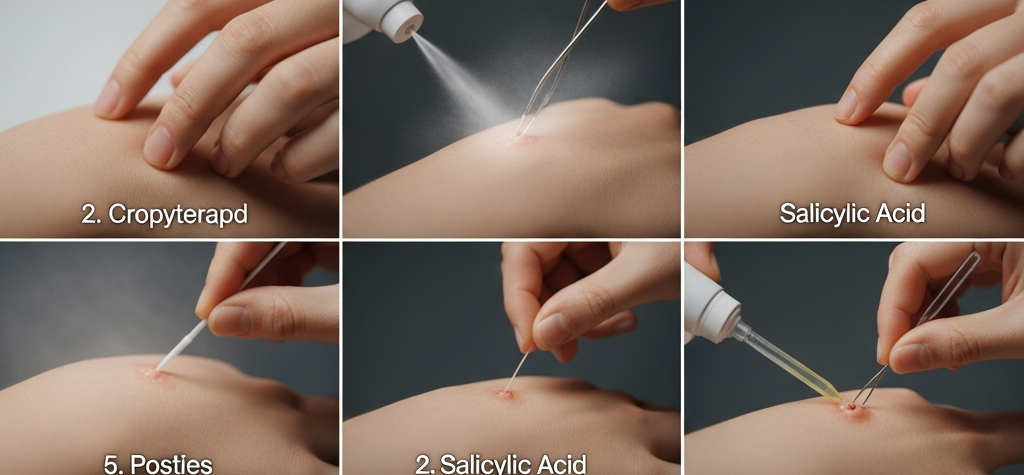
A typical dermatologist-recommended approach may involve:
- Softening the wart with warm water.
- Drying the area carefully.
- Gently removing loosened dead skin when appropriate.
- Applying the salicylic-acid product according to its directions.
- Repeating treatment consistently.
- Monitoring the surrounding skin.
The American Academy of Dermatology advises using a disposable emery board or pumice stone for the wart and not using the same tool elsewhere on the body because doing so may spread the virus. AAD: At-home wart treatment
What should you expect?
During treatment, the wart can look moist and pale. Some soreness or irritation may occur.
However, severe irritation is not something to push through simply because you want faster results.
AAD recommends stopping treatment temporarily if the skin becomes extremely sore or irritated and seeking medical advice if significant pain, bleeding, or blistering develops. AAD: At-home wart treatment
How Long Does It Take to Remove a Common Wart?
This is where realistic expectations matter.
A common wart usually does not disappear immediately after starting treatment.
NHS guidance says pharmacy treatments can take up to three months and may not always work. NHS: Warts and verrucas
Mayo Clinic also notes that treatment may take weeks or months. Mayo Clinic: Common warts diagnosis and treatment
That means this is not a good progress test:
“The wart is still visible after five days, so the treatment failed.”
A better question is
“Is the wart gradually changing while I am following the treatment correctly?”
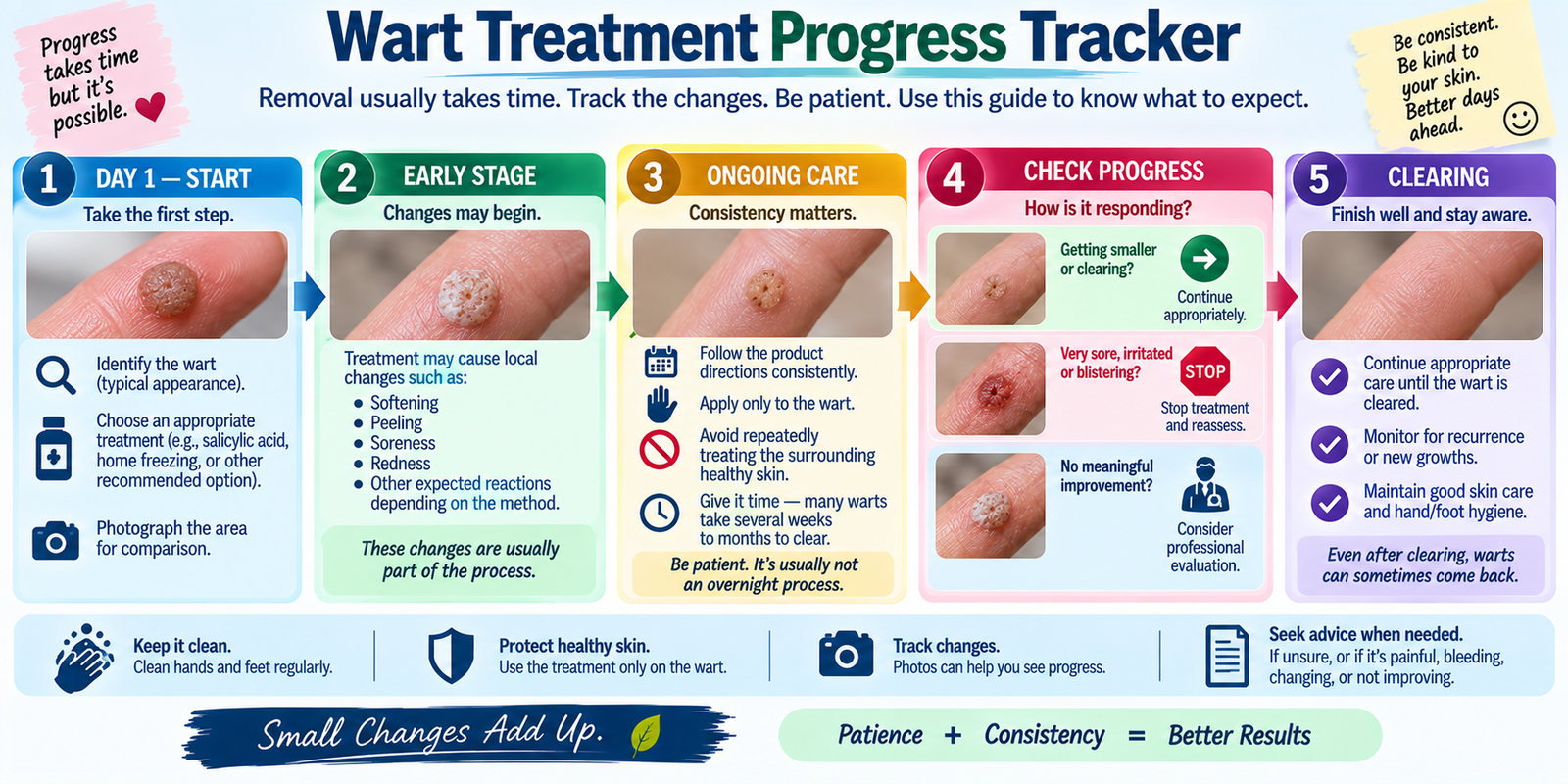
Progress can look like this.
| Treatment stage | What you may notice |
|---|---|
| First several days | Little visible change |
| Early weeks | The surface may soften. |
| Continued treatment | Wart may become thinner. |
| Later treatment | More normal skin may become visible. |
| After clearance | Monitor for recurrence. |
Do not keep adding stronger treatments simply because the process feels slow.
Home Freezing Products: What You Need to Know
Freezing is another option for some common warts.
However, there is an important difference between an over-the-counter freezing product and professional cryotherapy.
Dermatologists use cryosurgery, commonly with liquid nitrogen, to freeze wart tissue. The American Academy of Dermatology explains that professional cryotherapy may require more than one treatment, with repeat sessions sometimes performed every two to four weeks. AAD: Warts diagnosis and treatment
Home freezing products do not provide exactly the same treatment.
AAD says an at-home freezing product may help a small wart, but users should follow the package instructions carefully. AAD: At-home wart treatment
Possible problems with freezing
You may experience:
- Pain.
- Stinging.
- Itching.
- Blistering.
- Skin irritation.
- Temporary changes in skin color.
Professional cryotherapy can also cause blistering, pain, and, in some cases, scarring or pigment changes. Mayo Clinic: Common warts treatment
Do not assume that applying a freezing product for longer than recommended will produce a better result.
What About Duct Tape?
Duct tape has become one of the best-known home remedies for warts.
The evidence is not as straightforward as social media often suggests.
The American Academy of Dermatology lists duct tape as an at-home option, but it also acknowledges conflicting study results. AAD: At-home wart treatment
Mayo Clinic notes that several small studies have found duct tape does not work particularly well. Mayo Clinic: Common warts treatment
So I would not describe duct tape as a guaranteed wart remover.
It is better to place it in the “possible but mixed evidence” category.
What About Apple Cider Vinegar?
Apple cider vinegar is frequently promoted online as a natural wart remover.
The problem is that an acidic household substance should not automatically be considered a safe or proven wart treatment.
Burning or irritating the skin does not prove that the underlying wart has been successfully treated.
For that reason, I would not make apple cider vinegar a first-line recommendation for common wart removal.
A reader should have a clear reason to choose a treatment, not simply choose it because it is popular online.
What About Garlic?
Garlic is another traditional home remedy that appears frequently in online wart-removal discussions.
It should not be presented as equivalent to established treatments such as salicylic acid.
Raw garlic can irritate skin, particularly when it is left against the skin for prolonged periods.
If a home remedy has uncertain effectiveness and a realistic possibility of skin irritation, readers should know that before trying it.
What About Tea Tree Oil?
Tea tree oil is also frequently mentioned as a natural wart treatment.
However, it does not have the same established role as standard wart treatments such as salicylic acid.
Essential oils can also irritate skin or trigger allergic reactions.
For a health-focused article, it is more responsible to distinguish limited or uncertain evidence from established treatment options rather than putting every internet remedy into the same “top treatments” list.
The Wart Treatment Ladder
Instead of trying multiple remedies at once, use a simple decision framework.
| Your situation | Sensible next step |
|---|---|
| Small typical common wart | Consider an OTC salicylic-acid product. |
| Treatment recently started. | Follow the recommended course. |
| Gradual improvement | Continue according to instructions. |
| Mild irritation | Monitor and follow product directions. |
| Severe irritation | Stop and reassess. |
| No meaningful improvement | Consider professional assessment. |
| Wart keeps returning. | Get it reassessed. |
| Several new warts appear. | Consider medical advice. |
| Painful or bleeding lesion | Seek medical assessment. |
| Facial wart | Seek professional advice. |
| Genital lesion | Seek professional diagnosis. |
| Diabetes or poor circulation | Ask a healthcare professional first. |
| Weakened immunity | Seek professional guidance. |
This is one of the most important ideas in this article:
The strongest treatment is not automatically the best treatment for every person.
Location, diagnosis, skin condition, health history, and previous treatment all influence what makes sense.
What Exercise Can and Cannot Do for a Wart
Exercise does not directly remove a common wart.
There is no established reason to believe that sweating during exercise will eliminate the virus from a wart.
However, exercise environments can matter because warts are contagious and the virus can spread through skin contact or contaminated surfaces. Healthdirect notes that HPV associated with warts can spread through direct contact and contaminated surfaces such as swimming pools or gym environments. Healthdirect: How to treat warts
If you have a wart and regularly use a gym or swimming facility, practical hygiene becomes more important.
During exercise
- Cover the wart when appropriate.
- Wash your hands after touching it.
- Do not pick or scratch it.
- Do not share personal towels.
- Avoid walking barefoot in communal wet areas.
- Avoid shaving over the wart.
- Keep personal grooming equipment separate.
AAD specifically recommends washing hands after touching or treating a wart, covering warts when appropriate, and avoiding picking, scratching, or shaving over them. AAD: At-home wart treatment
So the fitness message is simple:
Exercise can remain part of your routine, but exercise itself is not a wart treatment.
How to Prevent a Wart From Spreading
Removing the visible wart is only part of the problem.
Warts are contagious, and the virus can spread to other areas of your own skin or to another person. American Academy of Dermatology: Warts FAQs
That makes everyday habits surprisingly important.
Try to
- Wash your hands after touching the wart.
- Avoid picking it.
- Avoid scratching.
- Avoid shaving over it.
- Do not share razors.
- Do not share towels.
- Do not share nail tools.
- Cover the wart when appropriate.
- Wear footwear in communal wet areas.
- Keep personal grooming equipment separate.
AAD recommends these types of precautions to reduce the risk of spreading the virus that causes warts. AAD: At-home wart treatment
A Simple Progress Checklist
Instead of examining the wart repeatedly every day, look for meaningful changes over time.
Possible signs of improvement
- The wart becomes smaller.
- The rough surface becomes thinner.
- The raised portion decreases.
- Less thickened tissue remains.
- Normal-looking skin becomes visible.
- No additional warts appear nearby.
Warning signs
- Severe pain.
- Significant bleeding.
- Increasing redness.
- Increasing warmth.
- Pus or other signs of infection.
- Rapid change in appearance.
- Severe surrounding irritation.
- The lesion no longer resembles the original wart.
If warning signs appear, do not simply increase the amount or frequency of treatment.
Why Does a Wart Keep Coming Back?
A returning wart can be frustrating.
It can also tempt people to search for an even stronger home remedy.
That is not necessarily the answer.
Mayo Clinic explains that even after treatment, common warts can return or spread. Mayo Clinic: Common warts diagnosis and treatment
Possible explanations include:
- The wart was not completely cleared.
- Nearby skin was exposed.
- A new wart developed.
- The original diagnosis was incorrect.
- The virus remained associated with the affected skin.
If the same lesion repeatedly returns, professional reassessment is more sensible than repeatedly escalating DIY treatment.
Common Wart vs. Genital Wart: Do Not Mix Them Up
This distinction is extremely important.
A common wart on the hand is not the same treatment situation as a genital wart.
Do not automatically use ordinary over-the-counter wart removers on genital lesions.
Mayo Clinic explains that nonprescription wart removers intended for common warts should not be used on genital warts. Mayo Clinic: Genital warts diagnosis and treatment
If you notice a new growth around the genital area, seek professional medical assessment rather than experimenting with acids, freezing products, or household remedies.
When Should You See a Dermatologist?
Knowing when to stop home treatment is just as important as knowing how to begin.
The American Academy of Dermatology recommends professional assessment if a wart is on the face or genital area, changes, hurts, itches, burns or bleeds, if there are many warts, if you are uncertain about the diagnosis, if home treatment has failed, or if you have diabetes or a weakened immune system. AAD: Warts diagnosis and treatment
Healthdirect also recommends seeing a doctor when warts are painful, spreading, infected, numerous, or located on the face, feet, or genitals, and advises people with poor immunity or pregnancy-related concerns to seek medical advice. Healthdirect: How to treat warts
Seek professional advice if
- The growth is changing.
- It bleeds.
- It becomes painful.
- It is rapidly increasing in size.
- It is on the face.
- It is on the genitals.
- There are many warts.
- Warts are spreading rapidly.
- You are uncertain that it is a wart.
- Home treatment has failed.
- You have diabetes.
- You have poor circulation.
- You have reduced sensation.
- You have a weakened immune system.
- You are pregnant or planning pregnancy and are unsure which treatment is appropriate.
What I Would Avoid When Removing a Wart at Home
Internet searches can make aggressive wart removal sound attractive.
That does not make it safer.
Avoid
- Cutting a wart off yourself.
- Burning it with household chemicals.
- Using concentrated acids that are not designed for wart treatment.
- Picking at the wart.
- Scraping healthy skin.
- Shaving directly over it.
- Using ordinary wart remover on genital lesions.
- Sharing pumice stones or files.
- Combining multiple irritating treatments.
- Continuing treatment despite severe irritation.
The objective is not to damage as much tissue as possible.
The objective is to treat the wart while protecting healthy skin.
Home Treatment Comparison
| Treatment | Where it is usually used | Evidence/role | Main limitation |
|---|---|---|---|
| Salicylic acid | Home | Established option for many common warts | Requires consistency |
| Home freezing product | Home | May help select small warts | Not equivalent to professional cryotherapy |
| Duct tape | Home | Evidence is mixed. | Can irritate skin |
| Professional cryotherapy | Clinic | Common medical treatment | Pain, blistering, and repeat sessions |
| Cantharidin | Clinic | Used for selected warts | Causes blistering |
| Curettage/electrosurgery | Clinic | Used for selected persistent warts | Can cause pain or scarring |
| Laser treatment | Clinic | May be considered for difficult cases | Not a routine home treatment |
The American Academy of Dermatology lists several professional options, including cryosurgery, cantharidin, electrosurgery, curettage, prescription treatments, and other therapies depending on the wart and patient. AAD: Warts diagnosis and treatment
Mayo Clinic also emphasizes that the appropriate treatment depends on factors such as wart location, symptoms, and individual preferences. Mayo Clinic: Common warts diagnosis and treatment
A Practical Decision Table
| Question | If your answer is “yes” | What to do |
|---|---|---|
| Is it a small, typical common wart? | Yes. | Home treatment may be reasonable. |
| Is it on your hand or finger? | Yes. | Consider an appropriate OTC option. |
| Can you follow treatment consistently? | Yes. | Follow product instructions. |
| Is the wart gradually improving? | Yes. | Continue as directed. |
| Is surrounding skin severely irritated? | Yes. | Stop and reassess. |
| Is it bleeding or rapidly changing? | Yes. | Seek medical assessment. |
| Is it on your face? | Yes. | Get professional advice. |
| Is it on your genitals? | Yes. | Do not use ordinary wart remover. |
| Do you have diabetes? | Yes. | Ask a healthcare professional first. |
| Do you have poor circulation or numbness? | Yes. | Get professional guidance. |
| Has appropriate home treatment failed? | Yes. | Consider a dermatologist. |
My Personal Insight
A wart can look like a very small problem.
The treatment decisions around it can become surprisingly complicated.
One common mistake is moving from remedy to remedy too quickly. Someone may try a pharmacy treatment for a few days, see little change, switch to vinegar, add garlic, scrape the surface, and then apply another product.
At that point, the surrounding skin may be more irritated than the original wart.
The better approach is slower and more deliberate:
Identify → choose → follow → monitor → reassess.
That is the approach I would want a reader to take after searching for how to remove common warts at home.
You do not need the largest possible list of remedies.
You need a treatment that fits the situation.
A 30-Second Wart Treatment Check
Before beginning home treatment, ask yourself five questions.
1. Does it really look like a common wart?
If you are uncertain, get it checked.
2. Is it in an appropriate location?
Facial and genital lesions should not be treated like ordinary hand warts.
3. Is it small and uncomplicated?
If yes, home treatment may be reasonable.
4. Can you follow one treatment consistently?
If you constantly switch remedies, it becomes difficult to judge what is helping.
5. Is your skin tolerating the treatment?
If severe irritation develops, stop and reassess.
This simple framework can prevent many unnecessary home-treatment mistakes.
Frequently Asked Questions
How can I remove a common wart at home?
For many people with one or a few small common warts, an over-the-counter salicylic-acid treatment is a reasonable starting option. Home freezing products may also be appropriate for selected small warts. AAD: At-home wart treatment
What is the fastest way to remove a common wart?
There is no single treatment that is fastest for everyone. Professional cryotherapy is a commonly used medical treatment, but repeat sessions may be required. Salicylic acid generally works gradually over weeks. AAD: Warts diagnosis and treatment
How long does common wart removal take?
Home treatment may take several weeks, and NHS guidance says some pharmacy treatments can take up to three months. Natural disappearance may take much longer. NHS: Warts and verrucas
Is salicylic acid good for common wart removal?
Yes. Salicylic acid is a commonly recommended home treatment and works by gradually removing layers of the wart. AAD: At-home wart treatment
Can I freeze a wart at home?
Some nonprescription freezing products are designed for home use and may help small warts. They are not identical to professional cryotherapy, so follow the product instructions carefully. AAD: At-home wart treatment
Does duct tape remove warts?
Duct tape may help some people, but evidence is mixed. It should not be presented as a guaranteed treatment. AAD: At-home wart treatment
Should I cut a wart off myself?
No. Cutting a wart yourself can injure surrounding skin and create additional problems. If an appropriate home treatment does not work, professional assessment is safer.
Can I use common wart remover on genital warts?
No. Ordinary nonprescription wart removers intended for common warts should not be used on genital lesions. Mayo Clinic: Genital warts diagnosis and treatment
Why does my wart keep coming back?
Warts can recur or new warts can develop nearby after treatment. If the same lesion repeatedly returns, professional reassessment may be appropriate. Mayo Clinic: Common warts diagnosis and treatment
When should I see a dermatologist for a wart?
See a dermatologist or other qualified healthcare professional if the wart changes, bleeds, becomes painful, spreads significantly, appears on the face or genitals, or does not respond to appropriate home treatment. Professional advice is also important if you have diabetes or a weakened immune system. AAD: Warts diagnosis and treatment
Author Note
I wrote this guide around one simple principle: readers need realistic wart-removal information, not a longer list of internet remedies.
The important question is not simply:
“What can I put on this wart?”
A better question is
“Is this really a wart, which treatment is appropriate, and when should I stop treating it myself?”
That difference can help readers avoid unnecessary skin irritation and wasted time.
Medical Disclaimer
This article is provided for general educational purposes and does not replace diagnosis, treatment, or personalized medical advice from a qualified healthcare professional.
Not every rough, raised, or changing skin growth is a wart. If you are uncertain about a lesion, do not rely solely on an online article for diagnosis.
Before using a wart-removal product, read and follow the manufacturer’s instructions. Seek professional advice if you have diabetes, poor circulation, reduced sensation, a weakened immune system, pregnancy, or another condition that could affect skin treatment.
Seek medical evaluation for a lesion that is rapidly changing, significantly painful, bleeding, infected, or otherwise concerning.
Fitness Disclaimer
Exercise does not directly remove common warts.
The fitness information in this article is limited to practical considerations such as hygiene, covering a wart, and reducing opportunities for spread in communal exercise environments.
This information is not a personalized exercise program. If you have a health condition, injury, or other concern affecting physical activity, consult an appropriately qualified healthcare professional.
Evidence-Based Sources
American Academy of Dermatology — Warts: Diagnosis and Treatment
American Academy of Dermatology — At-Home Wart Treatment
Mayo Clinic — Common Warts: Diagnosis and Treatment
Mayo Clinic — Common Warts: Symptoms and Causes
Healthdirect Australia — How to Treat Warts
Conclusion
If you are searching for how to remove common warts at home, you do not need to try every remedy you find online.
For a small, typical common wart, salicylic acid is one of the better-established home treatment options. Appropriate home freezing products may also help selected warts, while duct tape remains an option with mixed evidence. American Academy of Dermatology—At-Home Wart Treatment
The process usually requires patience.
Do not expect an ordinary wart to disappear overnight simply because a treatment feels strong. Do not cut or burn it yourself, and do not assume that every rough skin growth is a wart.
Most importantly, know when home treatment has reached its limit.
A sensible wart-removal strategy is not about finding a miracle cure. It is about identifying the problem correctly, choosing an appropriate treatment, using it consistently, protecting healthy skin, reducing spread, and getting professional help when necessary.
Related Articles
- 10 Best Workouts To Get Six Pack Abs at Home
- Terms & Conditions
- 12 Best Supplements for Skin Health
- 12 Significant Aging Effects on the Brain
- 10 Ways to Reverse Type 2 Diabetes Permanently
- Home